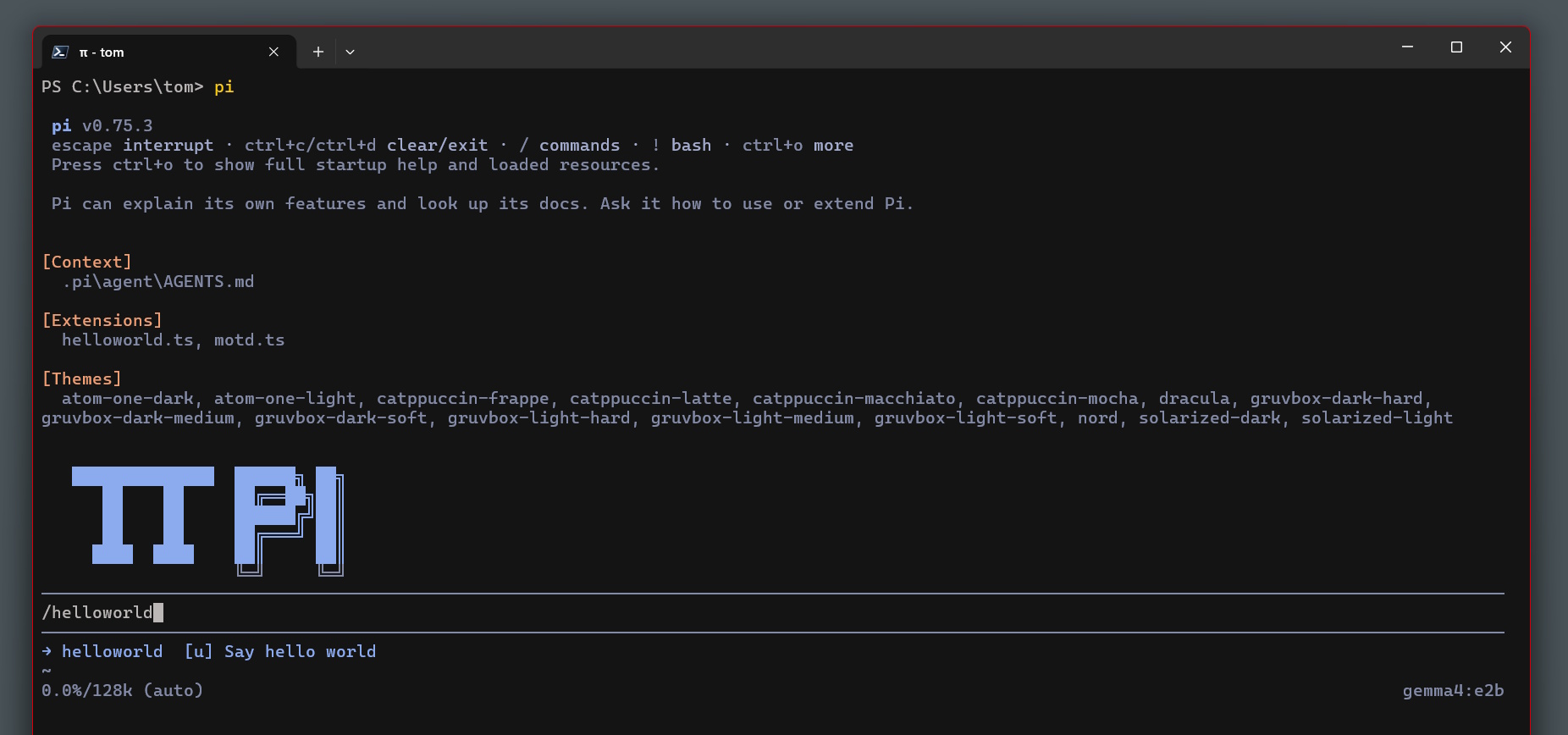
Terminal showing Pi Agent startup with skills and extensions loaded

Understanding Pi Agent's Extension Model: Context Files, Skills, and TypeScript Extensions

If like me, you’re spending an increasing amount of time learning Pi Agent - the minimal terminal coding harness - you’ll quickly hit the point where you want to bend it to your workflow. There are four different mechanisms for doing that: context files, prompt templates, skills, and TypeScript extensions. They look similar on the surface but they operate at completely different layers, and picking the wrong one means either burning context unnecessarily or writing TypeScript when a Markdown file would have done the job. ...

19 May 2026 · 9 min · Tom Cocking

Running Ollama in a Proxmox LXC with NVIDIA GPU Passthrough

Running large language models locally is genuinely useful — no API costs, no rate limits, and your data stays on your own hardware. The catch is getting GPU acceleration working inside a Proxmox LXC container, which involves a few non-obvious steps around driver installation and cgroup device passthrough. Why LXC and not a VM? VM GPU passthrough wasn’t an option here — no iGPU meant the host would have had no display output once the card was handed off. LXC was the practical solution, and it turns out to be a good one anyway: containers share the host kernel directly, so the GPU stays bound to the host’s NVIDIA driver and the container accesses it via bind-mounted device nodes and cgroup permissions. On top of that, LXCs are lighter weight than VMs, with less overhead and near-instant startup times. For a dedicated service like Ollama, it’s a solid fit. ...

22 March 2026 · 8 min · Tom